JEANON (1937-2023)
Creator of the “Jubilant Structural”. French painter, School of Paris.
1. Biography
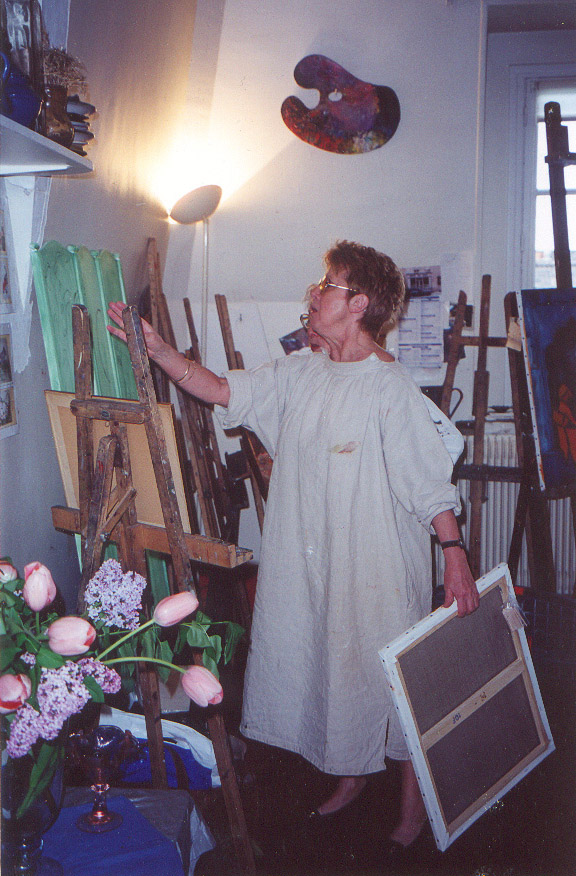
Jeanon, also known as Jeanine Gravelais, was a French painter whose work belongs to the great tradition of the School of Paris. Born in Saint-Étienne, she first trained as a sculptor at the National School of Fine Arts, where she won first prize. She then continued her apprenticeship with masters such as Fernand Majorel, Yves Brayer, Maryse Ducaire and Edouard Mac Avoy, who recognised her exceptional talent early on. Edouard Mac Avoy described her as “a brilliant painter and a profound analyst.”
The daughter of an industrialist from Saint-Étienne, Jeanon took drawing lessons from Mme Sauzet, a watercolourist, from the age of eight, followed by two years of embroidery. Despite the family expectations of the time, she firmly chose an artistic path. Her earliest works, copies after Watteau, Rembrandt or Carpeaux, reveal early technical mastery and an already distinctive sensitivity. The portrait she painted of her father, René Gravelais (1955), symbolically marks her artistic emancipation: a delicate, free and expressive work.
At 16, she met Jean Baptiste Pitre, an engineer who would become her husband and most faithful supporter. The couple settled in Lyon and then in Paris, where Jeanon devoted herself entirely to painting.
Defining encounters
In Paris, she attended the classes of Yves Brayer, a master of French figurative painting. His rigorous teaching shaped the foundations of her style: a sense of composition, the strength of colour, and an attachment to reality transformed by sensitivity.
In the 1970s, she became friends with the Russian painter Constantin Bruni, a post-impressionist who worked in Renoir’s former studio in Montmartre. He created sets for UNESCO and shared his research with Jeanon, as evidenced by many letters. He painted Jeanon’s portrait and acknowledged her talent for colour and drawing. With her husband, she supported him financially with great generosity until his death.
In 1982, under the guidance of Edouard Mac Avoy, a leading portraitist of his time at Le Lucernaire, she reached full artistic maturity. Under his demanding direction, she developed a rare ability to capture the essence of her subjects and the psychology of the gaze that would characterise her own portraits. First a gifted student and then his assistant, she inherited his studio and his students after his death.
Aware of the male dominance in the art world, she adopted the name Jeanon, chosen by her husband in reference to Juno, the Roman goddess of strength and courage.
She passed away in 2023. Jeanon left a considerable legacy of more than 2,000 works, three quarters of which were sold during her lifetime, and are now held by many collectors and art lovers around the world.
2. Training and learning
Art studies
National School of Fine Arts of Saint-Étienne, Sculpture (First prize, 1960)
Academy of Fine Arts of Lyon
Fernand Majorel Studio (Lyon, 1952–1961)
Yves Brayer Studio, La Grande Chaumière (Paris)
Maryse Ducaire Studio (Paris, 1977–1982)
Edouard Mac Avoy National Art Center, Le Lucernaire (Paris, 1982–1991)
A solid education, a free eye
Jeanon’s training at the National School of Fine Arts of Saint-Étienne, crowned by a first prize in sculpture, deeply shaped her relationship to form. This demand for volume, framing and construction runs throughout her work. In Paris, she continued her training with Yves Brayer, Maryse Ducaire and Edouard Mac Avoy, becoming his assistant. These encounters fed her technique without ever restricting her vision. Very early on, she asserted a personal, sensitive and vibrant style that set her apart in the Paris salons where she exhibited for more than thirty years.
Teaching
Jeanon taught painting and drawing for nearly forty years.
1990–1991: Head of the Mac Avoy studio at Le Lucernaire
1991–1994: Head of Jeanon’s Paris studio on Rue Censier
1993–2020: Head of the Jeanon studio on Rue du Rocher, Asnières
More than 120 students trained with her, some of whom became recognised artists, such as Boy Cloos.
4. Style: the “Jubilant Structural”
To present the work of Jeanon (1937–2023), also known as Jeanine Gravelais, is to enter a world where rigorous drawing meets rare chromatic energy. Trained first as a sculptor before becoming a painter, heir to the School of Paris yet fiercely independent, Jeanon built a body of work that explores the inner structure of the world while celebrating its vitality.
Her mineral style shapes oil paint with a palette knife and brushes to emphasise the richness of colour and the strength of line. Her work is a hymn to the beauty of the world around us. Her “Jubilant Structural” approach captures the fertile tension between mastery and freedom, between architecture and emotion.
Jeanon’s style is characterised by a sculptor’s approach to material, mixing oil paint, marble powder and sometimes pieces of burlap canvas in the backgrounds. It rests on an exacting command of structure, harmoniously framed composition, strong and precise drawing, and an anatomical rendering rooted in her early sculptural training.
To this architectural rigor she adds a particularly jubilant expression, with mastery of material and a choice of colour that is both nuanced and abundant, drawing on every range of chromatic language. She worked across techniques: graphite, charcoal, red chalk, watercolour, and above all oil and mixed media.
5. The four major pictorial periods
Magnificence (1951-1965)
In this youthful period, from 1951 to 1965, Jeanon drew her favourite subjects from those around her: portraits of loved ones and scenes of life in Haute-Loire. She observed them with wonder and narrated them with a characteristic softness and sensuality, exploring techniques such as red chalk, graphite and oil.
Kaleidoscope (1966-1999)
The years 1966 to 1999 correspond to the artist’s Paris period. The fulfilment of her life as a woman went hand in hand with a new mastery of painting. Jeanon explored rich, vivid and dynamic colour palettes, full of tenderness and joy. She began working with a palette knife, shaping space with a myriad of horizontal and vertical touches. This long period unfolds through successive technical explorations and a true staging of colour, which becomes the main subject.
Incandescence (2001-2003)
In this brief but intense period, Jeanon projected onto the canvas her struggle as a free woman. Her colour range centred solely on red, all reds: vibrant, wild, vermilion. She confronted material with a freedom of mark-making that brought her to the edge of abstraction.
Elementum (2003-2022)
During this period, Jeanon went to the heart of her subjects by capturing what emanates from natural matter. She returned to the representation of nature and expressed the raw force of the elements in a pared-down, calm and direct style. She could render stone as smooth, vegetation as tangible, and water as alive, within a structure that reveals what she always was: a sculptural painter paying homage to the generosity of the essential elements around us.
6. A body of work filled with life
Jeanon’s work unfolds as an exploration of the world. It is a spontaneous creative process, nourished by light, materials and emotions. Her life and art are inseparable, shaped by travel and insatiable curiosity.
From landscapes of the “Île de Dieu” in Provence to Venice, Corsica and Morocco, from scenes of Parisian life (La Défense, the Champs-Élysées, Chatou), jazz clubs and street scenes, her gaze settled on everything that moved her, seeking beauty even in imperfections.
Her fascination with animals (horses, cows, hens, dromedaries and above all cats) runs through her entire work. Her cats, free and independent, were given names of famous artists such as Goya, Picasso, Leonardo and Dalí, reflecting the diversity of her inspirations as well as her sense of play.
Her subjects explore the beauty of nature, in landscapes where light bursts forth through a rich and delicate palette. Flowers and trees, Jeanon captured their life. These works are intimate paintings: her gaze records the force of sensitive beauty, seeing beyond the image.
In her final years, she continued to paint and draw with inexhaustible energy, passing her passion on to her children, grandchildren and their partners. Her last unfinished canvas on the easel depicts lilies. The red underpainting remains visible, awaiting a final touch, a symbol of purity and passion. Jeanon’s last sketch, a drawing of one of her cats, offers a moving final point to a life devoted to the love of living things, which she captured and offered to the world.
7. Exhibitions and distinctions
Salons and regular exhibitions
Member of the Salon of Independents (since 1969)
Member of the Salon of French Artists (since 1984, Honourable Mention 1991)
Member of the Fine Arts Biennial (since 1981)
Member of the Autumn Salon (since 1981)
Deauville Salon 1990: 1st Grand Prize for Nude, Flowers and Portrait
Solo and group exhibitions
Saint Étienne (1960-1962)
Vichy (1965), Strasbourg (1982)
Galerie Bernheim Jeune, Paris, Venise en hiver (1986)
Camaret (1989)
Lyon (1989)
Montreux, Suisse, Gold medal (1990)
Deauville (1990)
Galerie des Halles, Neuchâtel (1992)
Galerie La Belle Épine (1993)
Black and White Biennial (1995, 1997)
Galerie Borelli (1997)
Galerie Le Sagittaire
Contemporary art salon (1997)
Grand Art Market, La Défense (1997)
Grand Art Market, La Bastille (1997, 1998)
Étampes City Salon (1997)
Galerie Schilderijen Primart, Hollande (1998)
Rond-Point des Champs-Élysées Gallery, Paris (1998)
APROART, Aubusson (2005)
International presence
For more than fifteen years, her works were presented at FIAC. They now circulate in private collections worldwide: United States, Hong Kong, Qatar, Switzerland, China, Russia, Japan, Spain, Italy, Australia.
8. Legacy
She passed away in 2023. Jeanon, a prolific artist, produced more than 2,000 paintings and just as many drawings, watercolours and red-chalk works.
Today, in her studio, she leaves a considerable heritage: more than 1,000 works, including 333 drawings and 47 sketchbooks, 155 watercolours and 268 paintings preserved.
Her influence continues through the many students she trained, and through the undiminished strength of her work, now being rediscovered and reassessed.
The family is now compiling a complete, annotated catalogue of her works to preserve and transmit her legacy, testimony to a unique style: mineral, sculptural, magnifying the beauty of living things, the Jubilant Structural.